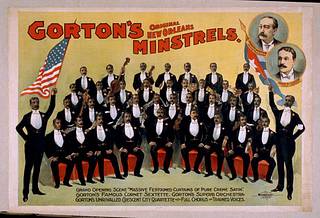

Gorton's Original New Orleans Minstrels
Summary
Includes small portraits of Jos. Gorton and Chas. H. Larkin.
8070 U.S. Copyright Office
Caption: Grand opening scene "Massive festooned curtains of cure creme satin." Gorton's famous cornet sextette. Gorton's superb orchestra. Gorton's unrivalled Crescent City Quartette with full chorus of trained voices.
Created and "copyright 1899 Courier Litho. Co., Buffalo, N.Y."
No. 2614.
Forms part of: Minstrel poster collection (Library of Congress)
Minstrelsy was an American form of entertainment developed in the 19th century. Each show consisted of comic skits, variety acts, dancing, and music, performed by white people in make-up or blackface for the purpose of playing the role of black people. Minstrel shows lampooned black people as dim-witted, lazy, buffoonish, superstitious, happy-go-lucky, and musical. The minstrel show began with brief burlesques and comic entr'actes in the early 1830s and emerged as a full-fledged form in the next decade. By 1848, blackface minstrel shows were the national artform, translating formal art such as opera into popular terms for a general audience. By the turn of the 20th century, the minstrel show enjoyed but a shadow of its former popularity, having been replaced for the most part by vaudeville. It survived as professional entertainment until about 1910; amateur performances continued until the 1960s in high schools and local theaters. As the civil rights movement progressed and gained acceptance, minstrels lost popularity. The typical minstrel performance followed a three-act structure. The troupe first danced onto a stage then exchanged wisecracks and sang songs. The second part featured a variety of entertainments, including the pun-filled stump speech. The final act consisted of a slapstick musical plantation skit or a send-up of a popular play. Minstrel songs and sketches featured several stock characters, most popularly the slave and the dandy. These were further divided into sub-archetypes such as the mammy, her counterpart the old darky, the provocative mulatto wench, and the black soldier. Minstrels claimed that their songs and dances were authentically black, although the extent of the black influence remains debated. Spirituals (known as jubilees) entered the repertoire in the 1870s, marking the first undeniably black music to be used in minstrelsy. Blackface minstrelsy was the first theatrical form that was distinctly American. During the 1830s and 1840s at the height of its popularity, it was at the epicenter of the American music industry. For several decades it provided the means through which American whites viewed black people. On the one hand, it had strong racist aspects; on the other, it afforded white Americans a singular and broad awareness of what some whites considered significant aspects of black culture in America. Although the minstrel shows were extremely popular, being "consistently packed with families from all walks of life and every ethnic group", they were also controversial. Racial integrationists decried them as falsely showing happy slaves while at the same time making fun of them; segregationists thought such shows were "disrespectful" of social norms, portrayed runaway slaves with sympathy and would undermine the southerners' "peculiar institution". Learn more at Wikipedia: en.wikipedia.org/wiki/Minstrel_show
The collection includes posters advertising individual plays and operettas, burlesque, vaudeville, and specialty acts, dance companies, extravaganzas produced by the Kiralfy Brothers, portraits of entertainers, and stock posters. Featured performers include Julia Arthur, De Wolfe Hopper, Joseph Hart Vaudeville Co., Thomas W. Keene, Andrew Mack, Robert B. Mantell, Mathews & Bulger, Lewis Morrison, Phil Sheridan's New City Sports Co., Royal Lilliputians, and Jennie Yeamans. Directors, managers, and producers include Edward J. Abraham, Blaney, and Vance, William A. Brady, Sidney R. Ellis, W.J. Fielding, Charles Frohman, Hoyt & McKee, the Kiralfy Brothers, Jacob Litt, Rice & Burton, Rich & Harris, A.Q. Scammon, Sam S. Schubert, Thall & Kennedy, Fred E. Wright, Charles H. Yale, and others. Playwrights include David Belasco, George H. Broadhurst, Bartley Campbell, Charles Turner Dazey, Gilbert & Sullivan, William Gillette, Seymour Hicks, David Higgins, Bronson Howard, Cecil Raleigh, William Shakespeare, Sutton Vane, and others. Plays include such popular titles as Arizona, At Piney Ridge, By the sad sea waves, Devil's auction, Evangeline, Faust, Female drummer, H.M.S. Pinafore, The hidden hand, The last of the Rohans, Ole Olson, The Queen of Chinatown, Shenandoah, Siberia, The sporting life, Uncle Tom's cabin, Venice, The war of wealth, Way down East, Yon Yonson, and others. Images depicted include scenes from plays, portraits of performers, and performers performing. Featured entertainers are not always depicted in the image. Some posters are mainly textual with peripheral images.
Tags
Date
Contributors
Source
Copyright info


