The World's Largest Public Domain Media Search Engine
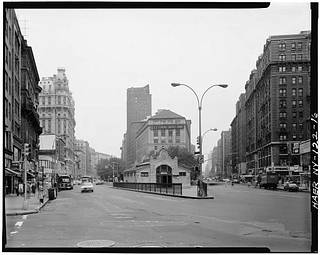
Interborough Rapid Transit Subway (Original Line), New York, New York County, NY

Similar

Interborough Rapid Transit Subway (Original Line), New York, New York County, NY

description

Summary

Significance: The IRT was New York City's first subway.
Unprocessed Field note material exists for this structure: N508
Survey number: HAER NY-122
Building/structure dates: ca. 1904 Initial Construction

New York Subway Historic Photos

The history of New York City's transportation system. New York City is distinguished from other U.S. cities for its low personal automobile ownership and its significant use of public transportation. New York is the only city in the United States where over half of all households do not own a car (Manhattan's non-ownership is even higher, around 75%; nationally, the rate is 8%). New York City has, by far, the highest rate of public transportation use of any American city. New York City also has the longest mean travel time for commuters (39 minutes) among major U.S. cities. The Second Industrial Revolution fundamentally changed the city – the port infrastructure grew at such a rapid pace after the 1825 completion of the Erie Canal that New York became the most important connection between all of Europe and the interior of the United States. Elevated trains and subterranean transportation ('El trains' and 'subways') were introduced between 1867 and 1904. Private automobiles brought an additional change for the city by around 1930, notably the 1927 Holland Tunnel.

The history of the subway, or underground railway, dates back to the 19th century. The first underground railway was the Metropolitan Railway in London, which opened in 1863. It was proposed for London by Charles Pearson, a city solicitor, as part of a city-improvement plan shortly after the opening of the Thames Tunnel in 1843. The subway quickly became a popular mode of transportation in urban areas, as it allowed people to travel quickly and efficiently through the city. Over time, many cities around the world built their own subway systems, and today, subway trains are a common sight in many major cities. The technology used in subway systems has evolved over time, and modern trains are faster and more efficient than ever before.

label_outline

Tags

date_range

Date

1904
person

Contributors

Historic American Engineering Record, creator
Hoffman
Craven, Alfred
Andrews, George H
Harvey, Charles
Davenport, John Isaacs
Barclay, William
Belmont, August
Church, Simon
Vanderbilt, Commodore
Vanderbilt, Cornelius
Rapid Transit Commission
Gould, Jay
Sage, Russell
Ryan, Thomas Fortune
Whitney, William C
Marshall, Alfred
Sweet, C W
Hewitt, Abram S
Depew, Chauncey
Sterne, Simon
Orr, Alexander E
Grant, Hugh
Wilson, R T
Corbin, Austin
Parsons, William Barclay
Low, Seth
McDonald, John B
Roosevelt, Theodore
Onderdonk, Andrew
Freedman, Andrew
Croker, Richard
Belmont, August
Schiff, Jacob
Hedley, Frank
Turner, Daniel L
Riis, Jacob
Weber, Adna F
Maltbie, Milo Roy
Willcox, William R
Arnold, Bion J
Morgenthau, Henry
Barney, Charles T
Rice, George S
Bryan, E P
Stillwell, Lewis B
Gibbs, George
Bradley, William
Naughton & Company
Farrell, Hopper & Company
Rodgers , John C
Seaman, Harry
Sprague, Frank J
Fransioli, William
Vleck, John Van
Phelps, William C
General Electric Company
Westinghouse
Hutchinson, Cary T
Duncan, Louis
Armorite Conduit Company
Westinghouse, George
Waldron, J M
Heins, George L
LaFarge, Christopher Grant
Hunter, Paul C
Thompson, W T
American Car & Foundry Company
Chandler, Charles F
Soper, Geroge A
Starr, John E
Interborough Rapid Transit Company
Warner, John DeWitt
Sagarin, David, photographer
Katz, Wallace B, historian
Hood, Clifton, historian
Scott, Charles, historian
Kimmelman, Barbara, historian
Framberger, David J, historian
place

Location

public
create

Source

Library of Congress
copyright

Copyright info

No known restrictions on images made by the U.S. Government; images copied from other sources may be restricted. http://www.loc.gov/rr/print/res/114_habs.html

Explore more

subways
subways
picryl logo

The World's Largest Public Domain Media Search Engine

PICRYL is the largest media source for public domain images, scans, and documents. PICRYL is an AI-driven search & similarity engine. PICRYL makes the world's public domain media fun to find and easy to use.

Get Archive LLC, creator of PICRYL, endeavors to provide information that it possesses on the copyright status of the content and to identify any other terms and conditions that may apply to the use of the content, however, Get Archive LLC offers no guarantee or assurance that all pertinent information is provided, or that the information is correct in each circumstance.

Permission for use, re-use, or additional use of the content is not required. GetArchive believes there are no usage restrictions or limitations put on content in the U.S. Get Archive LLC does not charge permission and license fees for use of any of the content on PICRYL, however, upon request, GetArchive can provide rights clearance for content for a fee.

Get Archive LLC is the owner of the compilation of content that is posted on the PICRYL website and applications, which consists of text, images, audio, video, databases, tags, design, codes, and software ("Content"). However, Get Archive LLC does not own each component of the compilation displayed and accessible on the PICRYL website and applications. If you have specific questions or information about content, the website, and applications, please contact us.

Developed by GetArchive, 2015-2025